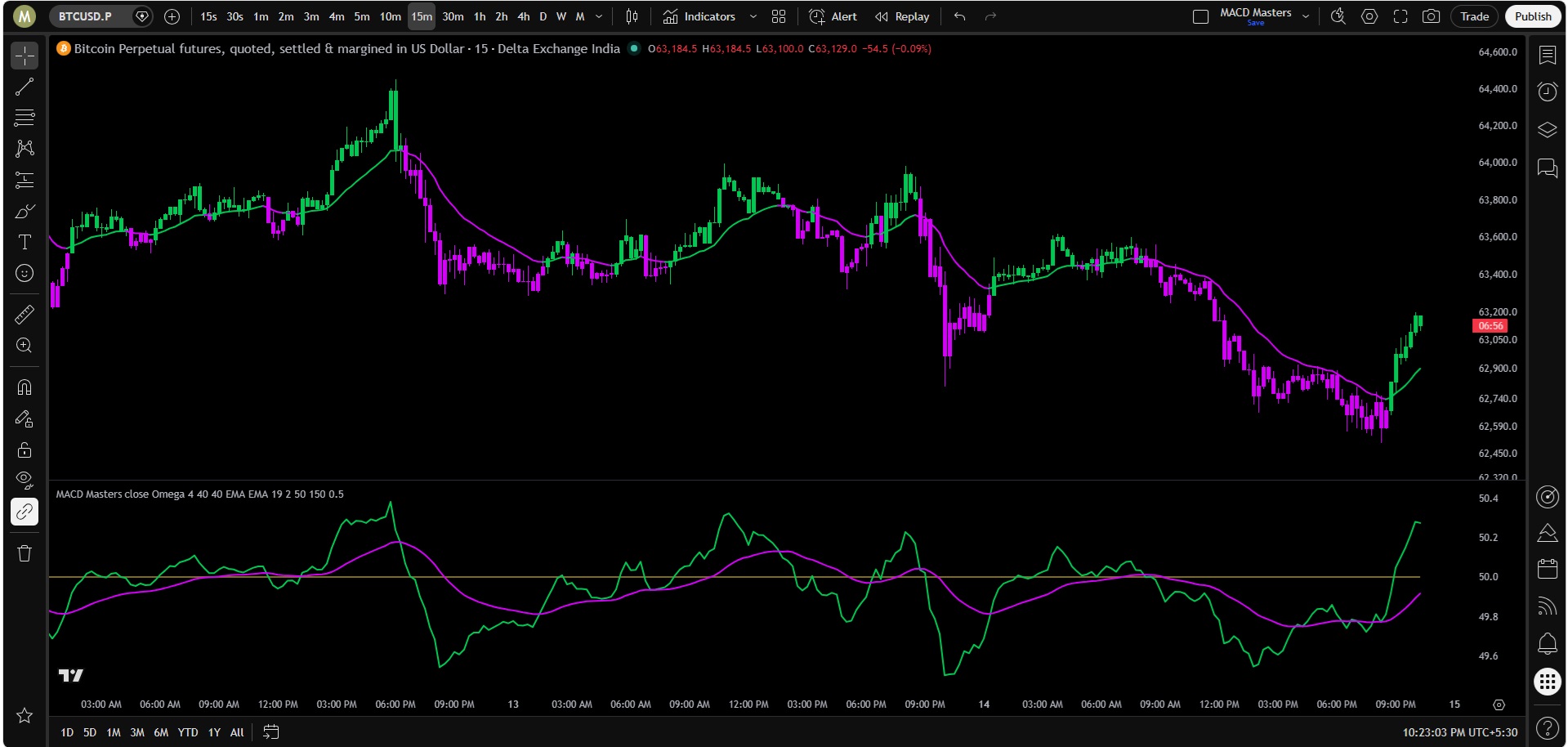
Description
Overview
MACD Masters is a pure MACD-based signal engine built for traders who want a clean, momentum-driven read on price without the added weight of a secondary oscillator. The indicator’s foundation is the Moving Average Convergence Divergence (MACD) — the relationship between a fast-moving average and a slow-moving average of price, and the signal line that smooths that relationship — used both as a visual reference and as a strict trigger for long and short conditions.
The design goal behind MACD Masters was simplicity without sacrificing precision. Rather than layering multiple oscillators together, the indicator concentrates entirely on MACD behaviour: the crossover between the MACD line and its Signal line, filtered by which side of the zero line that crossover takes place on. This keeps the logic transparent and repeatable across instruments, timeframes, and market regimes.
The Engine — How MACD Masters Reads Momentum
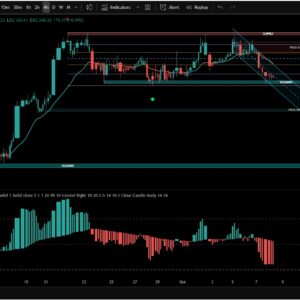
At its core, MACD Masters calculates a fast moving average and a slow moving average of price (the type of average — exponential or simple — is user-selectable), takes the difference between them to form the MACD line, and then smooths that MACD line to form the Signal line. The zero line represents the point at which the fast and slow averages are in agreement — above zero, the fast average leads; below zero, the slow average leads.
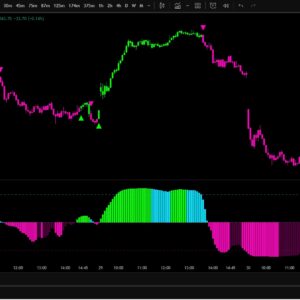
A Long condition is generated only when the MACD line crosses above the Signal line while the MACD line itself is already above the zero line — meaning the crossover is happening on the bullish side of the momentum axis, not in a neutral or bearish zone. A Short condition mirrors this exactly on the downside: the MACD line must cross below the Signal line while sitting below the zero line.
This zero-line filter is deliberate. A crossover that happens close to zero, in either direction, is treated as a lower-conviction, transitional signal and is not flagged. Only crossovers that occur with clear directional bias behind them qualify — a design choice intended to reduce noise during choppy, directionless conditions.
Evolution — Arriving at the Final Settings
The MACD settings used in MACD Masters were not chosen arbitrarily. They are the product of extended live observation and iterative refinement across multiple market conditions, instruments, and timeframes over time. Different fast/slow/signal length combinations were tested, tracked, and compared for how cleanly they captured genuine momentum shifts versus how often they produced false or premature signals.
Out of this process, a small number of length combinations consistently stood out as reliable across different conditions. These were carried forward and given their own identities within the indicator, so a trader could switch between tested, proven configurations instantly rather than re-entering numbers from memory or trial and error on a live chart.